

Economic transformation, where does Albania rank? Financial stability appears positive, but property rights "unlock"

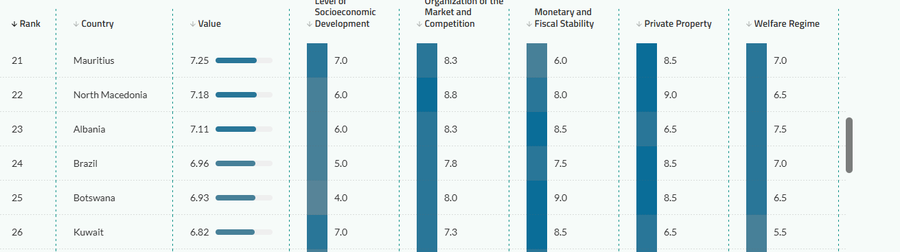
Albania ranks 23rd in terms of economic transformation, among 137 countries considered. The state of economic transformation, according to the BTI index, is measured according to seven criteria, which are based on a total of 14 indicators. Some of the indicators measure not only economic performance, but also competition policy and property rights. The index also includes social security and compensation, equality of opportunity and sustainability.
In terms of socio-economic development, Albania is rated with 6 points, an indicator that highlights the need for further improvement in living standards, income, and access to quality services for citizens.
On the other hand, market organization and level of competition appear as a strong point, with 8.3 points. This result suggests a relatively open and functional environment for business, where enterprises operate under competitive conditions and with fewer barriers compared to other areas.
Monetary and fiscal stability is even more positive, with a score of 8.5. This indicator shows that the country has managed to maintain a stable level of financial policies, managing inflation and public debt in a relatively controlled manner.
However, one of the most problematic areas remains private property, which is assessed with only 6.5 points. This shows that issues related to property rights, registration and legal certainty continue to be challenging and require deeper institutional reforms. Regarding the welfare regime, Albania receives 7.5 points, reflecting an average level of social protection and public services.
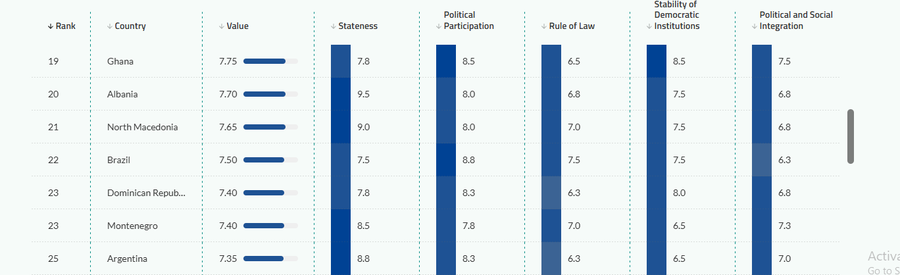
In terms of political and institutional aspects, Albania ranks 20th, with a total score of 7.7 points, showing a relatively stable performance compared to other countries on the list. One of the strongest points is the functioning of the state (“stateness”), which is assessed with 9.5 points, reflecting good institutional control and the capacity of the state to exercise authority in the territory.
For the first time, Albania is producing military vessels - What will KAYO's agreements with the two private companies specifically include?
The Albanian state-owned company, KAYO, responsible for the production and trade of weapons, is collaborating with two other private companies to build......

Albania, tax-free for pensioners from abroad - Draft law, pension income is exempt from tax
The government aims to return Albania to a preferred residence destination for foreign retirees and the Albanian diaspora, by promoting what is called the......
$30 million per hour - The amount oil companies earned from the Iran war
The world's 100 largest oil and gas companies earned more than $30 million every hour in the first month of the US-Israeli war in Iran. Saudi Aramco, Gazprom......

The US Dollar Weakens Again - What Happened in the Foreign Exchange Market Today?
The US dollar, after the recovery it recorded yesterday, has started the day negatively, being bought today at 80.7 lek and being sold at 82 lek, although......
War does not affect China's economy - It grows more than expected in the first quarter
China's economy grew faster than expected in the first quarter of the year, despite global turmoil caused by the US-Israeli war with Iran. Gross domestic......

Electricity tax cut imminent - War with Iran spurs EU proposal
Electricity taxes could be cut under a new EU proposal to offset the impact of the Iran war on energy prices. A draft proposal from the European Commission,......

IMF warns countries - “Abandon extensive fuel subsidies”
The war in the Middle East has intensified pressures on an already fragile global fiscal situation, with higher interest rates and rising energy prices......
US, net oil exporter - For the first time since World War II, as a result of the war with Iran
The United States became a net exporter of crude oil last week for the first time since World War II, as shipments rose near a record high to meet demand......