



Draft law, Government approves the new model of organization and accountability in state administration


The Media and Information Agency informs you that the Council of Ministers today approved the draft law "On some amendments to the law on the organization and functioning of the state administration".
After 14 years of implementation, one of the fundamental acts that regulates the activity of the state administration is being amended with the aim of modernizing the organization and increasing the accountability of public institutions, in order to bring them closer to the best European standards.
In order to increase accountability and transparency, the draft law establishes a unified performance monitoring system in the state administration, standardizing the planning and reporting processes from all institutions subordinate to the responsible ministries. For the first time, the performance reports of each institution will be published for citizens, strengthening transparency and enabling a clearer assessment of the results achieved by the public administration.
The draft law reconceptualizes the organization of non-ministerial institutions, dividing them into two main categories: dependent institutions and autonomous agencies. The changes aim to clarify responsibilities, strengthen oversight, and increase the accountability of institutions to the responsible ministries and the center of government.
Another important objective of the reform is to prevent the fragmentation of the administration into a large number of subordinate institutions. In this context, the draft law limits the creation of institutions with a small number of employees, whose functions can be absorbed or exercised more efficiently by the relevant ministries.
At the level of internal institutional management, the draft law strengthens the role of general directorates, which will now be the highest decision-making instance for routine processes, except in cases where the law assigns the minister or secretary general to make the decision, reducing the current centralization of decision-making.
One of the key elements of the reform is the definition of criteria for the transfer of institutions under the Prime Minister, with the aim of avoiding overloading the center of government and ensuring its focus on intersectoral coordination and the government's strategic priorities. The draft law provides that new structures be created only when necessary, with a time-limited mandate and linked to clearly defined objectives.
The most tangible impact of the reform on citizens is expected to come through the establishment of clear rules for the recruitment, career development and dismissal of employees of public services operating under the Labor Code, including hospitals, schools and social institutions. The aim is to guarantee the highest standards of professionalism, integrity and performance in the services that citizens receive every day.
Overall, the proposed changes, agreed upon with the European Commission and OECD/SIGMA, aim to build a modern, innovative and accountable administration, which is measured not only by its procedures and results, but also by the concrete impact it has on improving the lives of citizens.

Around 1 billion euros from tourists at the beginning of the year/ The net balance of tourism expanded to over 360 million euros in the first three months of 2026
Tourism continues to be one of the strongest engines of the Albanian economy in 2026. Balance of payments data show that during the first quarter of the......

Transportation and energy prices rise significantly - ASK: Inflation in Kosovo reaches 6.8 percent
The Kosovo Agency of Statistics (KAS) has published the Harmonized Index of Consumer Prices (HICP) for May 2026, applying the new COICOP 2018 classification......

Cash still dominates transactions in Albania - BoA: Over 553 billion lek circulated at bank counters during the first quarter of the year
Cash continues to remain one of the most widely used forms of transactions in Albania, despite the increase in electronic payments and the use of online......

Reform in administration, EU assesses Albania's progress - Pirdeni: ASPA expands trainings, 540 participants from the private sector
Public administration reform and civil service modernization remain among the main priorities in Albania's European integration process. During her report......

The French model of criminal asset management - AAPSK and ARO expand international cooperation
A delegation of the Agency for the Administration of Seized and Confiscated Assets (AAPSK) and the Asset Recovery Office (ARO), led by the Chief......

Labor force participation rate reached 76.2%/ Agriculture leads employment decline, services show growth
According to the latest data published by the Institute of Statistics (INSTAT), the labor market in Albania presents a mixed picture in the first quarter of......

Hoxha at SEECP: Albania's path towards the EU has entered the most decisive phase, the aim is to close negotiations by 2027
Minister for Europe and Foreign Affairs, Ferit Hoxha, participated in the Ministerial meeting of the South East European Cooperation Process (SEECP) taking......
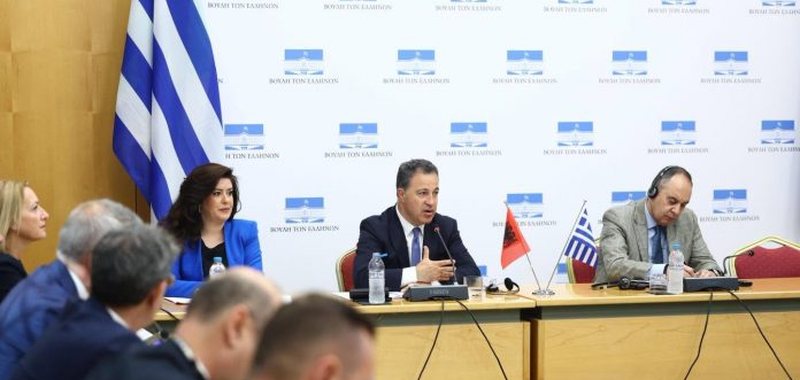
Peleshi meets in Athens with Plakiotakis: Greece supports Albania's European journey and strengthening parliamentary cooperation
The Speaker of the Albanian Parliament, Niko Peleshi, held an official meeting in Athens with the Chairman of the Committee on European Affairs and First......